

The facts are interesting. But what you really need is what to actually do.
You're not imagining it. Night-time really is when itchy skin gets bad - and there's a solid reason why.
Just like the rest of the body, skin follows a circadian rhythm. Research shows the rate at which skin loses moisture is significantly higher at night than during the day [1]. For eczema-prone skin that's already working hard to hold onto hydration, the knock-on is simple: drier skin which itches more.
Then there's temperature. As your child settles into sleep, their skin surface temperature rises - and that triggers histamine release. Histamine is what makes skin feel itchy [2]. So your baby or toddler isn't being dramatic at 10pm. Their skin is literally responding to what their body is doing.
The good news is that most of the things that actually help target exactly these two processes. Here's what works.
The most important thing you can do: soak and seal
Before anything else in the evening, get this right.
A lukewarm bath of 10-15 minutes rehydrates the outer layer of skin. But the bath itself isn't the goal - it's what comes after. For about three minutes after getting out, skin is more permeable and absorbs moisturiser far better than usual. This window is short. If you're still wrestling pyjamas onto a wriggly toddler five minutes later, you've missed it - and the bath can actually make dryness worse as the water evaporates.
This is called "soak and seal" and it's the foundation of most eczema skin care routines used by dermatologists and Plunket nurses alike.
What it looks like in practice:
- Lukewarm water only. If it feels warm on your wrist, it's too hot. Hot water causes the skin surface temperature to rise - which, as above, triggers histamine.
- Pat dry, not rub, leaving skin slightly damp.
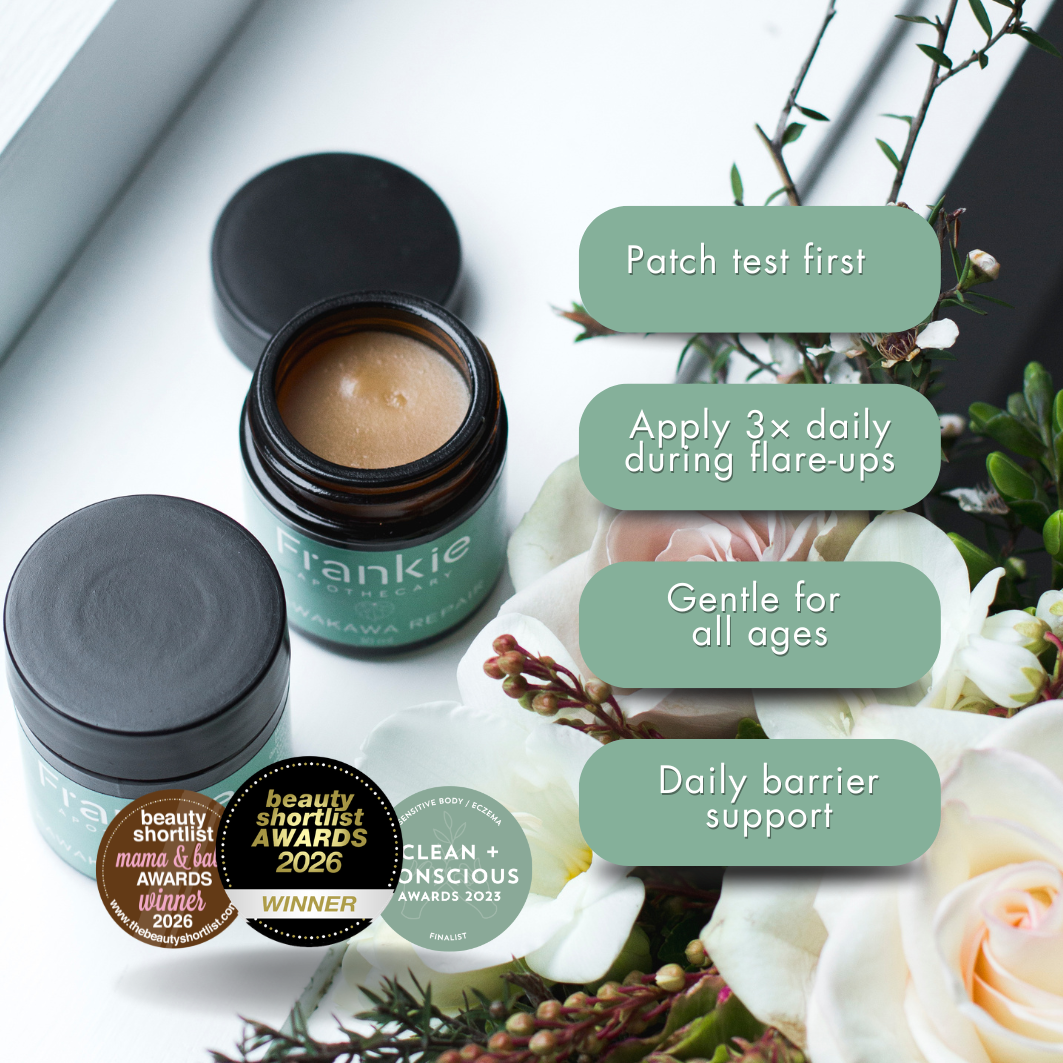
- Apply Kawakawa Balm immediately. Start with wherever itches most.
- Get cotton pyjamas on straight away.
If your toddler is in a particularly bad patch, adding a colloidal oatmeal soak makes a real difference. Oatmeal contains compounds that help calm reactive skin - and crucially, colloidal oatmeal gets suspended in water and leaves a protective protein layer on the skin that helps reduce moisture loss.
Frankie Apothecary's Soothing Oat Bath Soak is made with fine organic oats. When you follow the bath with the Kawakawa Balm, the two work together - the oat layer and Kawakawa Balm's unique four-wax blend combine to trap moisture to the skin more effectively than either would alone. For many families dealing with eczema-prone skin, this combination has become the non-negotiable part of the bedtime routine.

The cool flannel trick (and why it actually works)
This is one of the simplest things you can do, and it's completely free.
Cooling the skin activates nerve fibres that compete with itch signals - a process called gate control. When those cold signals arrive, they reduce the intensity of the itch reaching the brain. It's the same reason pressing a cold pack on an insect bite stops the itching.
For toddlers, the practical version:
- Keep two or three flannels (face cloths) in the fridge during the day.
- At bedtime or when itch peaks, press a cool damp flannel gently onto the worst spots -- behind the knees, inside the elbows, neck and ankles are usually the main culprits.
- Hold it there for 30-60 seconds.
It also gives your child's hands something to do other than scratch. Even young toddlers can learn to "press the cold cloth" - framing it as something they're doing, not something being done to them, tends to land better. Keep a small bowl of water on the bedside table on bad nights and re-cool the flannel as needed.
Sort the bedroom out
Room temperature is one of the most overlooked factors. Around 18°C is the target - warmer than that and you're back to increased sweating and histamine release. In a NZ summer or spring, an open window usually does it. In winter, if you're using heating, keep it lower than you'd normally have it - a room that feels comfortable to you at rest is often too warm for a sleeping child. The bedroom should feel slightly cool when you go in to settle them.
Bedding: Wash sheets and pillowcases at 60°C - hot enough to kill dust mites, which are among the most common environmental triggers for reactive skin. Weekly during flares, fortnightly otherwise. Avoid wool underlays in direct contact with skin. If your child seems to react to their sleeping environment specifically, dust mite-proof pillow and mattress covers are worth trying.
Humidity: Very dry air makes dry skin worse - in winter when heating is running, bedroom humidity can drop significantly. A cool mist humidifier aimed at 50-55% relative humidity can help. Below 40% and you'll feel the difference in your own skin too.

Pyjamas: it matters more than you'd think
Even pyjamas labelled "cotton" can have a polyester blend, and synthetic fibres are a common irritant for reactive skin. Look for:
- 100% cotton, no blend
- Loose fit -- tight elastic at the waist and ankles is a frequent culprit
- Seams turned inside out if they're rough against skin
- Labels cut out
In summer one cotton layer is ideal. In winter, layer cotton rather than reaching for one thick synthetic garment. Cotton onesies with covered feet are useful for kids who go for their ankles at night. On really bad nights, cotton gloves (available at most pharmacies) can reduce scratch damage without the drama of mittens.
Build the routine and keep it consistent
Predictability matters more than people expect. Anxiety and tiredness both amplify itch -- a worked-up, overtired toddler will itch significantly more than a calm, sleepy one [3]. Keeping the routine the same every night means their nervous system is already primed for sleep before the itching has a chance to ramp up.
Keeping the last 20 minutes before bed calm and dimly lit also matters -- light suppresses melatonin production, the hormone that signals to the body that it's time to sleep, and an overtired wired toddler takes longer to settle and itches more in the process.
A routine that works for many NZ families:
- Lukewarm oat bath (10-15 minutes)
- Pat dry, moisturiser on within 3 minutes
- Cool flannel on actively itchy spots
- Cotton pyjamas on
- Kawakawa Balm on the driest, most irritated patches - many parents find doing this after pyjamas (rather than right out of the bath) means it sits on the skin rather than being wiped straight off
- Low light, quiet activity - a story, soft music
- Sleep

Keep the nails short
It's boring but it matters. Short, filed nails do far less damage during overnight scratching than clipped ones with sharp edges. Check them every few days during flares. Some parents put a thin layer of barrier cream on fingernails and fingertips at bedtime -- it doesn't stop the scratching, but it reduces abrasion.
When things are really bad: wet wrapping
Wet wrapping is a clinical technique used in paediatric dermatology during acute flares. Moisturiser is applied, then affected areas are wrapped in damp cotton bandages or damp cotton clothing, with a dry cotton layer on top. The sustained moisture reduces transepidermal water loss overnight and creates a cooling effect on the skin. For families dealing with severe eczema-prone skin, it can break the itch-scratch cycle when nothing else is making a dent.
Check with your GP or dermatologist before trying it - they can advise on technique and flag whether there's any open or infected skin that would make it unsuitable. The NZ Eczema Association (eczema.org.nz) has practical guidance on wet wrapping written specifically for NZ families.
About the Kawakawa Balm
Kawakawa (Piper excelsum) has been used in rongoā Māori - traditional Māori medicine - for generations. Frankie Apothecary's Kawakawa Balm is wild-harvested and hand-packed during peak potency using traditional rongoā techniques. University of Auckland researchers have examined the botanical properties of kawakawa - we've always believed traditional knowledge was the authority, and it's satisfying to see science catching up.
What sets the Kawakawa Balm apart from many balms on the market is its unique four-wax blend, which reduces moisture loss from the skin more effectively than simpler formulations of oil and beeswax. It's fragrance-free, contains no synthetic preservatives, and is suitable for babies and toddlers from birth.
With more than 856 five-star reviews from NZ and Australian families -- many of them parents who've been managing reactive skin in young children for years and have tried a lot of things - it's become the product people reach for on dry patches, rough spots, and areas that have been scratched overnight.

Wild-harvested kawakawa, hand-packed during peak potency using traditional rongoā rākau techniques. Our Kawakawa Balm has a unique four-wax blend to trap moisture to the skin. Ships across New Zealand and the world. frankieapothecary.co.nz
Our mission
At Frankie Apothecary, we know how exhausting it is to be a parent dealing with eczema-prone or sensitive skin night after night. Our mission is to support as many whānau as we can with products that are natural, effective, and honest about what they do. The Kawakawa Balm is made for families like yours. We hope it helps you on your itchy skin journey.
Frequently asked questions
Why does my toddler itch more at night than during the day?
Skin loses significantly more moisture overnight, and for eczema-prone skin that means it becomes drier - drier skin itches more [1]. At the same time, skin surface temperature rises as the body prepares for sleep, which triggers histamine release which can increase the itch too [2]. Managing night-time itch is largely about managing these two processes: keeping skin hydrated and keeping skin cool.
What temperature should my child's room be?
Around 18°C is the target most dermatologists point to. Warmer rooms increase sweating and histamine release, both of which make itching worse. In NZ summers an open window usually does the job. In winter, keep heating low enough that the bedroom feels noticeably cool - more than you'd keep a living room.
Does bathing help or make things worse?
It helps - if you do it right. A lukewarm 10-15 minute bath rehydrates the skin and creates a window where moisturiser absorbs far more effectively. The catch is the timing: you need to apply moisturiser within three minutes of getting out. Wait longer and the benefit is largely lost, and the bath can leave skin drier than before.
What does the cool flannel method actually do?
Cooling the skin activates nerve fibres that compete with itch signals, reducing their intensity - this is called gate control. Pressing a cool damp cloth onto itchy skin can reduce the sensation for several minutes. It also gives little hands something to do instead of scratching. Keeping a few flannels in the fridge during the day means you have them ready when you need them.
What pyjamas are best for eczema-prone skin?
100% cotton, loose fit, no synthetic blend. Turn them inside out if the seams are rough, and cut out any labels. In winter, layer cotton rather than switching to something thicker and synthetic. Cotton onesies with covered hands and feet are worth having for children who scratch at night.
When should I see a GP?
If you are concerned, suspect any infection or need advice, we recommending seeing your GP, rongoā practitioner or Naturopath as the first port of call. They can assess for secondary infection, discuss options, and refer to a paediatric dermatologist if needed.
Is Kawakawa Balm suitable for toddlers?
Yes. The Kawakawa Balm is suitable from birth, fragrance-free, and contains no synthetic preservatives. It has more than 856 five-star reviews from NZ and Australian families, many of them parents managing eczema-prone skin in young children.
New Zealand resources
The NZ Eczema Association (eczema.org.nz) runs a helpline, has practical guides on wet wrapping and skin care routines, and can connect families with specialist support. Well worth bookmarking.
Plunket nurses and Well Child providers are also a useful first point of contact if you're unsure whether what you're seeing needs medical assessment.
Photos by Richard Stachmann and Annie Spratt on Unsplash
References
[1] Yosipovitch G, Xiong GL, Haus E, et al. Time-dependent variations of the skin barrier function in humans: transepidermal water loss, stratum corneum hydration, skin surface pH, and skin temperature. J Invest Dermatol. 1998;110(1):20-23.
[2] Yosipovitch G, Sackett-Lundeen L, Goon A, et al. Circadian and ultradian (12 h) variations of skin blood flow and barrier function in non-hairy skin of the forearm: with emphasis on night-time variations. Br J Dermatol. 2004;151(2):442-448.
[3] Fishbein AB, Mueller K, Kruse L, et al. Sleep disturbance in children with moderate/severe atopic dermatitis: a case-control study. Pediatr Dermatol. 2018;35(5):584-591.