

Caring for a baby is tiring (okay, exhausting!). It's also some of the most meaningful work you'll ever do, even on the days when it doesn't feel that way. So before we get into nappies and cradle cap, a quick word for you: the feeds, the changes, the 3am settling all count. We see you.
Every nappy change is an act of love
Your baby depends on you for everything, and that can feel like a lot, especially the first time around. Some days it really is just another nappy. But on the good days, it can help to see those small, repeated jobs for what they are: hundreds of tiny moments of care, every single day.
You're also literally shaping your child's future
With every clean nappy, every warm bath, every soothing cuddle you are hardwiring your child's heart and mind for a healthy, balanced life full of empathy and care. Children who experience nurture from a person who is a reliable and available caregiver in their first 3-4 years will grow and thrive to the point where they can regulate their own systems, experience full empathy, and create beautiful relationships throughout the length of their lives.
"The human brain and heart that are met primarily with empathy in the critical early years cannot and will not grow to choose a violent or selfish life.” - Robin Grille, Pyschologist & Parent Educator.
If you want to know more, we love Pennie Brownlee's Dance with me in the Heart.
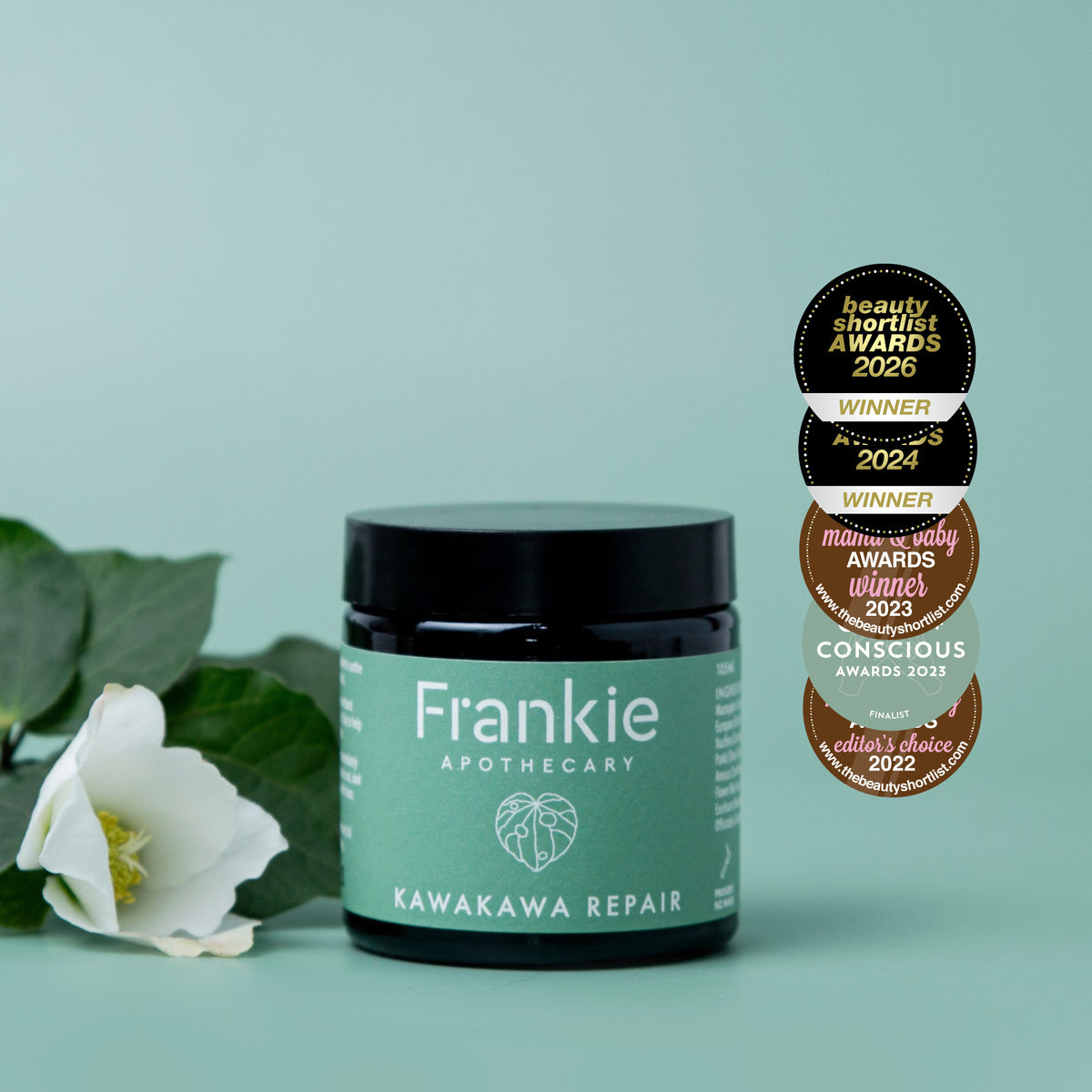
For daily baby care, we love Kawakawa Repair Balm
Eczema in babies
Dry, itchy and eczema-prone skin
Honestly, our favourite part of running Frankie Apothecary is hearing from parents whose little ones are comfortable and happy in their skin again. Kawakawa Balm soothes dry, itchy skin, and it's suitable for sensitive skin. There's no water, no fragrance and no essential oils, just a rich, simple balm made with wild-harvested kawakawa.
We care about this so much that we wrote a whole article on caring for your baby's eczema-prone skin. You can also read what other families say in the reviews at the bottom of this page.
"My 3 month old son has severe eczema and asked our GP for help. They prescribed him with steroidal creams which worked then it would come back again when stopped, he was mostly fussy. I started weaning off these steroidal creams as I was afraid that it was too strong for him. I slowly tried Frankie balm on my baby and it worked wonders on his skin! Now he's a happy and bubbly!" - Romana
"Highly recommend this pack, it's a life saver to my bubba! We have been battling with her eczema for months. All GP prescribed was antibiotics and stronger steroid which is not helping. The first day we tried it out, immediately we saw the results. Her skin is less itchy and cracked. Now she is so much happier!! Thank you ❤" - Colleen
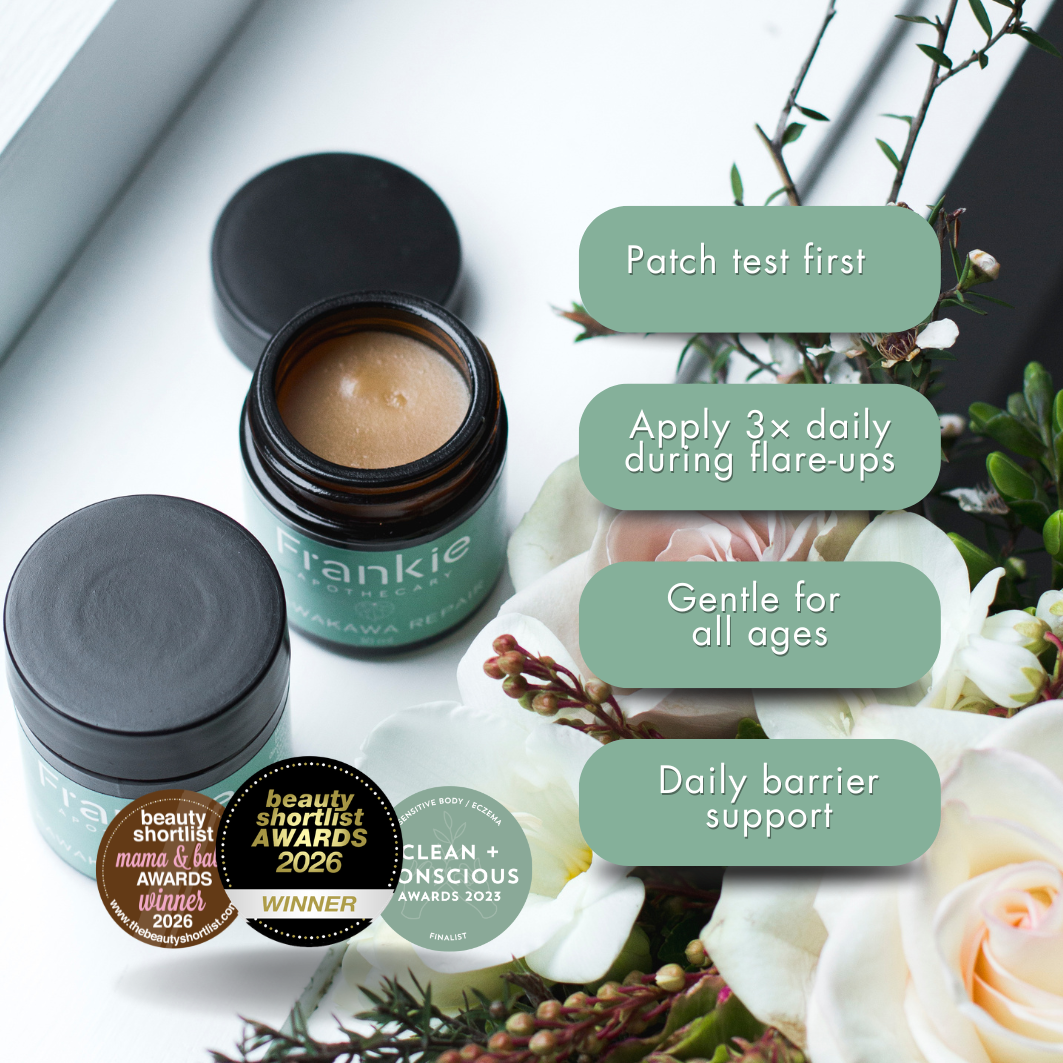
As with anything new, patch-test first. If your baby's skin is very inflamed, broken or weeping, check in with your GP or Plunket nurse.
Dribble rash & teething rash
Some babies are just dribblier than others, and teething turns the tap right up! All that moisture sitting on the chin, cheeks and in those cute chubby neck creases can leave skin red, chapped and sore. It's a bit like windburn that never gets the chance to dry out.
What helps:
- Dab, don't rub. Gently pat skin dry with a clean, soft muslin.
- Swap damp bibs and clothes often, so wet fabric isn't sitting against the skin.
- Keep a barrier on. Smooth a thin layer of Kawakawa Balm over the area after you dab dry, and reapply whenever you need to through the day. Keep it outside the mouth.
We recommend that you dab the area dry and apply the balm throughout the day. Instead of our standard advice to apply the Kawakawa Balm three times a day, go ahead and double this, to six applications daily. You're likely to be dealing with a steady supply of new moisture, so use a very clean muslin cloth to gently dab-dry and reapply to keep that barrier on baby's skin as much of the time as possible.
"I buy the kawakawa balm for my mokos. Our newest pēpi loves it for both her teething and nappy rashes. I think her māmā also sneaks it for her little grazes and dry skin patches too." - Shirley


Cradle cap
Cradle cap is really common, and it's nothing to worry about. It shows up as a waxy, flaky layer on your baby's scalp, and it usually clears up on its own over time. There's no need to get rid of it all at once. The aim is just to keep it soft and clean.
Using Kawakawa Balm
Smooth a little Kawakawa Balm onto the flaky patches and let it sit to soften them. Some parents do this before bed so it can work overnight. Pop a few layers of soft muslin over the pillow to keep the oils off the pillowcase. Or you can apply a little a few times through the day.
Once the flakes have softened, very gently massage your baby's scalp with a soft muslin or towel. Then glide a soft baby comb (one with rounded tips) over the scalp to lift away any flakes that are already loose.
Only remove what's ready to come away. Never use the comb to scrape or lift flakes that are still attached, because that can leave the skin underneath raw and sore. Gentle is best.
You can repeat this over a few nights, as long as your baby is comfortable. Wash any leftover balm out with warm water and a soft cloth, or leave it on.
You can repeat this treatment over several nights as long as it is comfortable for bub. You can wash the remainder of the balm out with warm water and a soft clean cloth, or leave it on the scalp.
Prefer something lighter?
For those who prefer to use oil which is lighter than the balm, our Kawakawa Body Oil is an excellent option for cradle cap. Apply as above to the scalp, leave overnight for for a few hours and repeat the process above - place a muslin cloth over baby's head and gently massage the scalp through the cloth. Then comb the hair to remove any skin that is already loose. Do not use the comb to try to lift skin as that can remove skin that isn't ready leaving an open area or wound where infection can be introduced. Gentle is best.

Nappy rash
What can I put on my baby's nappy rash?
The most common cause of nappy rash is simple: wetness sitting against the skin for too long, plus the rubbing of the nappy itself. The best things you can do are the simplest:
- Change often, and straight away after a poo.
- Pat dry gently rather than wiping hard.
- Give your baby some nappy-free time whenever you can, so the skin gets a chance to breathe.
Thinking about your nappies
Little ones with eczema-prone or sensitive skin can be more reactive, and sometimes the nappy itself plays a part. Disposable nappies are made from plastics like polyethylene and polypropylene, and many contain added lotions. A 2018 review by France's health and safety agency, ANSES, found traces of a range of chemicals in disposable nappies.
If your baby's skin is very prone to nappy rash, you could keep a stash of cloth nappies for when their skin is having a hard time, or go cloth all the way. Cloth can still rub, so keep them very clean and change them often.
Kawakawa Balm as a nappy barrier
At each change, smooth a light layer of Kawakawa Balm over the areas where wetness sits and along the crease of your baby's bottom. If the skin looks red, apply a slightly thicker layer there. It's suitable for sensitive skin, but you can patch-test first to be extra sure.
If the rash is blistered, weepy or broken, or it isn't settling after a few days, check in with your GP or Plunket nurse.
Sore, cracked nipples
This one's for you, māmā! It's really common for nipples to feel tender or crack a little when you first start breastfeeding, and it usually settles within the first week or so. If they become very painful, bleed or weep, or just aren't getting better, talk to your midwife, a lactation consultant or your GP. Often a small change to the latch makes a big difference.
To care for sore nipples, gently pat them dry with a clean, soft cloth after a feed, then smooth on a little Kawakawa Balm and wipe any excess off before the next feed. If you can, give them some fresh air for a while too (free the nipple!).
It's also worth swapping disposable nipple pads for natural wool or wool/silk pads. Disposable pads can hold damp against your skin, while natural fibres breathe. Nature Baby, Breastmates and The Sleep Store all have lovely options.
Dry hands and a balm for the whole whānau
All that hand washing after nappy changes takes a toll! Kawakawa Balm is lovely for creating a barrier on hands that are dry and chapped from frequent washing. Keep a jar by the sink or in the changing bag.
Skin can also feel drier or more sensitive during pregnancy and while breastfeeding. A little balm on dry patches, elbows and knees can help soothe dry, itchy skin.
It's one of those jars that ends up being used by everyone in the house. Just no double dipping!
Sun defence for sensitive skin
Babies skin is so delicate and precious that we do recommend using hats and shade to protect them from the harsh Kiwi sun, but when they go out in the sun to swim or play, it's important to use a beautiful, natural, gentle but high sun protection factor sunblock.
Natural Sun Defence SPF40 is such a good choice for babies, as it is nature-derived, free from chemical sun filters, and soft enough to easily smooth on young skin. It has been dermatologically tested as safe for sensitive skin, and has a proven SPF40 rating which means it stops 97.5% of UVB rays.
We are here to help you take great care of your beautiful bundle, so you can make the most of your time as the parent of a tiny person, and enjoy the convenience of one product that offers so many baby-care solutions. If you have any questions about using Kawakawa Balm for your baby, reach out via the chat button lower right - we are always happy to help!
Grab your Kawakawa Repair Balm here.